.png)

“Let your vision be world embracing.”
- Bahá’u’lláh
11 - 14 Years
England and Wales - KS3
Please scroll down - or click through - to find presentations and links to video materials, and in some cases, to lesson plans and worksheets.
-
The Life of the Spirit
We are always looking for ways to improve and extend what we can offer. So if you have time to tell us about your experiences of using any of our materials, do please get in touch: schools.resources@bahai.org.uk
.jpg)
Baháʼí House of Worship, Kinshasa,
Democratic Republic of Congo (DRC)
An Introduction to the Bahá'í Faith
God, the Creator of the universe, is all-knowing, all-loving and all-merciful. Just as the physical sun shines on the world, so the light of God is shed upon all Creation.
Throughout history, God has sent to humanity a series of divine Educators - known as Manifestations of God - whose teachings have provided the basis for the advancement of civilization.
These Manifestations have included Abraham, Krishna, Zoroaster, Moses, Buddha, Jesus, and Muhammad. Bahá’u’lláh, the latest of these Messengers, explained that the religions of the world come from the same Source and are in essence successive chapters of one religion from God.
Bahá’ís believe the crucial need facing humanity is to find a unifying vision of the future of society and of the nature and purpose of life. Such a vision unfolds in the writings of Bahá’u’lláh.
What are the Bahá’ís? What do they believe? What do they do? This presentation provides a basic introduction to the Faith.

The Central Figures
Bahá’u’lláh and His Covenant
The Bahá’í Faith began with the mission entrusted by God to two Divine Messengers - the Báb and Bahá’u’lláh.
Today, the distinctive unity of the Faith They founded stems from explicit instructions given by Bahá’u’lláh that have assured the continuity of guidance following His passing.
This line of succession, referred to as the Covenant, went from Bahá’u’lláh to His Son ‘Abdu’l-Bahá, and then from ‘Abdu’l-Bahá to His grandson, Shoghi Effendi, and the Universal House of Justice, ordained by Bahá’u’lláh.

A Bahá’í accepts the divine authority of the Báb and Bahá’u’lláh and of these appointed successors.
The Central Figures
In the middle of the 19th century a young merchant announced that He was the bearer of a message destined to transform the life of humanity.
At a time when His country, Iran, was undergoing widespread moral breakdown, His message aroused excitement and hope among all classes, rapidly attracting thousands of followers. He took the name “The Báb”, meaning “the Gate” in Arabic.
With His call for spiritual and moral reformation, and His attention to improving the position of women and the lot of the poor, the Báb’s prescription for spiritual renewal was revolutionary. At the same time, He founded a distinct, independent religion of His own, inspiring His followers to transform their lives and carry out great acts of heroism.
The Báb announced that humanity stood at the threshold of a new era. His mission, which was to last only six years, was to prepare the way for the coming of a Manifestation of God Who would usher in the age of peace and justice promised in all the world’s religions: Bahá’u’lláh.

The Báb
(1819-1850)
The Central Figures
Bahá’u’lláh
(1817-1892)
In the In the middle of the 19th century, God summoned Bahá’u’lláh—meaning the “Glory of God”—to deliver a new Revelation to humanity. For four decades thousands of verses, letters and books flowed from His pen. In His Writings, He outlined a framework for the development of a global civilization which takes into account both the spiritual and material dimensions of human life.
Bahá’u’lláh suffered 40 years of imprisonment, torture and exile for bringing God’s latest message to humanity. Today, His life and mission are becoming increasingly well-known across the planet. Millions of people are learning to apply His teachings to their individual and collective lives for the betterment of the world.

The Central Figures
‘Abdu’l-Bahá
(1844-1921)
Upholding unity as the fundamental principle of His teachings, Bahá’u’lláh established the necessary safeguard to ensure that His religion would never suffer the same fate as others that split into sects after the deaths of their Founders. In His Writings, He instructed all to turn to His eldest Son, ‘Abdu’l-Bahá, not only as the authorized interpreter of the Bahá’í Writings but also as the perfect exemplar of the Faith’s spirit and teachings.
Following Bahá’u’lláh’s passing, ‘Abdu’l-Bahá’s extraordinary qualities of character, His knowledge and His service to humanity offered a vivid demonstration of Bahá’u’lláh’s teachings in action, and brought great prestige to the rapidly expanding community throughout the world.


The Life of the Spirit
The Soul: Our True Identity
Every human being possesses an immortal, rational soul that passes through this world for a brief time and continues for eternity to advance towards God. This is our true identity.
The purpose of our lives is to know God and to attain His presence.
We pass through this world for a brief time. Our life’s purpose is to turn to God, and to progress spiritually by serving our fellow human beings. In doing so, we acquire the divine qualities we will need in the life to come.
Walking a path of service to God and to humanity gives meaning to our life and prepares us for the moment when the soul separates from the body and continues on its eternal journey towards its Maker.

The Life of the Spirit
Prayer and Meditation
Baháʼís believe that the purpose of our lives is to know God and to attain His presence. Our true identity is our rational soul, whose free will and powers of understanding enable us to continually better ourselves and our society. Walking a path of service to God and to humanity gives life meaning and prepares us for the moment the soul separates from the body and continues on its eternal journey towards its Maker.

Just as our bodies require nourishment to develop properly, Bahá’ís believe that we need regular prayer for our spiritual sustenance and health. Prayer is food for the soul; it deepens the love of God in our hearts and draws us closer to Him. Through prayer we may praise God and express our love for Him, as well as beseech Him for assistance.
The capacity to meditate is a distinguishing feature of the human being. Human progress - spiritual, material, or social - would be impossible without reflection and contemplation. Bahá’u’lláh wrote: “The source of crafts, sciences and arts is the power of reflection.”
The Life of the Spirit
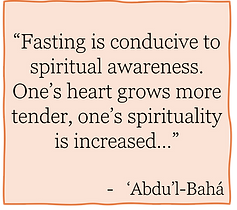
Fasting
Fasting has been a significant practice of religion throughout human history. Many of the Manifestations of God Themselves went through a period of meditation and fasting at some point in Their lives during which, in intense communion with God, They contemplated the mysteries of the universe and the nature of Their mission.
Bahá’u’lláh designated a nineteen-day period each year during which adult Bahá’ís fast from sunrise to sunset each day. This period coincides with the Bahá’í month of Alá—meaning Loftiness—from 2 to 20 March, which immediately precedes the Bahá’í new year. It is a time of prayer, meditation, and spiritual rejuvenation.
This presentation explores the Bahá’í approach to fasting.
The Life of the Spirit
Pilgrimage
Among the practices prescribed by Bahá’u’lláh for his followers is that of pilgrimage, principally to the Bahá’í Shrines in the Holy Land.
Pilgrims are taken to Bahá’u’lláh’s prison cell in Akká, to the house where He was subsequently confined, and to the two houses in the countryside just outside of Akká where He ended his days. He was interred in a building next to His final residence, which became the Shrine of Bahá’u’lláh.
Pilgrimage also includes prayer at the Shrine of the Báb on Mount Carmel, where His remains were interred, many years after his execution, at the direction of Bahá’u’lláh.
The Bahá’í Shrines have been designated by UNESCO as World Heritage sites, and welcome many visitors each year.
The effect of the experience upon each pilgrim is naturally personal and individual. Visits to the different historical and sacred sites take place in companionship with fellow Baháʼí pilgrims from around the world, allowing each pilgrim to take back both personal glimpses and shared experiences.
There is no obligation to go on pilgrimage where an individual does not have the resources
.jpg)
The Shrine of the Báb on Mount Carmel
The Life of the Spirit
A Life of Generous Giving
The human soul was created to give generously.
We fulfil our highest purpose in a life of service, in which we offer our time, energy, knowledge, and financial resources.
The impulse to give springs forth from the love of God. As this love fills our hearts, generosity comes to characterize the pattern of our conduct. When we serve others for the love of God, it is not for the hope of recognition and reward, nor for fear of punishment.
A life of service to humanity implies humility and detachment, not self-interest and ostentation.

Baháʼí Community Life
Baháʼí community life is rich and varied. Baháʼís meet regularly for devotional gatherings, for study classes, for childrens' classes and junior youth groups, for Baháʼí Holy Days and at summer schools. All of these activities are open to all. But the bedrock of Baháʼí community life is the Nineteen Day Feast.
The Nineteen Day Feast
On the first day of every Bahá’í month – every nineteen days – the Bahá’ís in each locality come together at the “Nineteen Day Feast”. This consists of three parts: a devotional, a community consultation and a social part. They are all important.
The Feast provides an opportunity for the community for the Local Spiritual Assembly - the local governing council of the Bahá’í community - to keep abreast of the concerns of the community and strengthen its relationship with it. Consultation at these regular gatherings also creates a space for growing social consciousness to find constructive expression and often leads to the emergence of small groups engaged in action.
The social part is fellowship, usually over shared food and sometimes entertainment. Everyone should enjoy each other’s company.
The Feast was ordained in the Kitáb-i-Aqdas by Bahá’u’lláh. He counselled His followers to meet once every Bahá’í month, even if “only water be served”.
The devotional consists of prayers and readings from the Bahá’í Sacred Texts, often in several languages, read by various members of the community.
The consultation is where Bahá’ís share news, discuss local issues and the progress of the Faith, and make plans.

This video shows members of a Bahá’í community in the UK talking about the Nineteen Day Feast and inviting viewers to observe this gathering.
Bahá’í Houses of Worship
Worship can take place anywhere, but most Bahá’í devotional meetings take place either in a private home or in a Bahá’í Centre. In the future, each town or village will have its own Mashriqu’l-Adhkár, or House of Worship.
The institution of the Mashriqu’l-Adhkár, translated as “The Dawning Place of the Mention of God”, was ordained by Bahá’u’lláh Himself. It is a pivotal concept of Bahá’í community life, giving concrete expression to the unity of devotion and service.
The physical structure of a Mashriqu’l-Adhkár comprises a central building—a House of Worship—along with several dependencies. While the Mashriqu’l-Adhkár forms the focal point of worship in a geographical area, its purpose is not solely to provide a place for prayer. ‘Abdu’l-Bahá explained that, through the provision of education, healthcare and other services it is also to support the social and economic progress of the community and afford shelter, relief and assistance to those in need. In this connection, ‘Abdu’l-Bahá anticipated that subsidiary branches—such as a hospital, school, university, dispensary, and hospice—would gradually be added to a House of Worship.
Each House of Worship is circular in shape and has nine sides. It is open to people of all races and of all religions or none. The architecture of some of these buildings is very striking. The most well-known are probably the Houses of Worship in New Delhi, popularly known as the Lotus Temple, and in Santiago, Chile.

Bahá’í House of Worship, Wilmette IL (just north of Chicago), USA. Opened in 1953, it is known as "the Mother Temple of North America "
Useful links
Websites

The official website for
the Bahá'í's of the
United Kingdom.

The official website for
the worldwide
Bahá'í Community.

The official website for the Bahá'í International Community at the UN.

The Bahá'í World
news service.

A photographic narrative of the life of the founder of the Faith, Bahá'u'lláh.

Celebrations for the 200th anniversaries of
the births of The Báb
and Bahá'u'lláh.

Collections of multi-faith meditations on numerous topics such as peace.

A popular blog or articles, videos and music.

The offical UK Bahá'í Children's magazine
for ages 5-12 years.

The official US Bahá'í Children's magazine
Videos & Animations

Inspirational stories of people from diverse nations whose lives have been transformed by
the Bahá'í Teachings.

The history of the growth of the Bahá'í community, from 'Abdu'l-Bahá's passing in 1921 to the present day.

Exemplar follows the life of ‘Abdu’l-Bahá and the profound effect He had
on people both past and present.

Experiences from Bahá'ís and their friends from around the world who are striving to build vibrant communities.

Young and old, in cities and villages around the world, are taking part in
a process of community building based on concepts enshrined in
the Bahá’í Teachings.

Young people from the UK discuss the problems facing the world and how Bahá’u’lláh’s message offers a healing remedy to address these issues.

We all feel the need to belong somewhere, but are the ways in which we are trying to satisfy this need actually bringing us closer together?

Communication is an important building block for society, but often public discourse is divisive and centred around conflict. Is there an alternative?